
A Year of
Never Impossible
Letter from the Board Chair and CEO
Dear friends,
We're proud to report that Mighty Earth is finding ways to deliver outsized impact even in this era of enormous political challenge for nature and climate.
The pages that follow detail some of the highlights:
- An unprecedented commitment from the world’s largest cattle company to reduce methane pollution by one-third, ban destruction of native ecosystems throughout their supply chain; and a requirement to trace the origin of their cattle.
- We’ve built a global movement to stop the “world’s largest deforestation project” - Indonesia’s food and energy estates with the goal of shifting investment into nature conservation and restoration.
- Our campaign to decarbonize heavy industry is driving major automakers to make initial investments in producing steel and aluminum without coal – and starting to scale the production of green hydrogen.
- Our work is featured prominently in the world’s most important media outlets (and perhaps even more importantly, in decision-makers' social media feeds). Just one example: our expedition with The New York Times to Borneo landed on the front page – and is sparking big companies to stop sourcing from destruction, restore orangutan habitat, and mitigate damage to local communities.
- Our rewilding program to restore mountain lions and other keystone species in North America has gone from a glimmer in our eye to a campaign with real momentum for paws on the ground.
- The Tropical Forest Forever Facility launched with the support of billion-dollar investments from Brazil and Indonesia (among others) – offering promise of finally making trees worth more alive than dead.
To be sure, there are serious political obstacles to the broader mission. Indeed, although work on the private sector continues to deliver the kind of outsized results listed above, most governments are ignoring or, worse, actively accelerating the extinction and climate crises.
We’ve seen the United States gut protections for 58.5 million acres of old-growth forests and marine protected areas alike; the Europe Union delay and weaken its Deforestation Regulation; and other countries deprioritize funding for conservation.
In response, Mighty Earth is focusing on two approaches – and we need your help with both:
First, we’re making the case to philanthropists that private sector action is what is actually delivering impact for nature and climate – even in the face of distracted or hostile governments.
Second, we’re arguing for dramatically scaling advocacy campaigns on government and companies alike. The environmental movement has drifted away from a focus on building political support for action – and wildlife and climate are suffering the consequences.
Stopping the evisceration of nature protection – and certainly achieving the aim of restoring what’s lost – is going to mean shifting resources away from writing technical reports and analyses that repeatedly fail to command the attention of government leaders and towards strategically-focused campaigns that force at least some of their attention on the transcendent issues of our times.
Mighty Earth is – as ever – delivering outsized impact for nature. But we can do so much more if we scale this extraordinarily effective lever.
We can't do this alone. Our impact is fueled by your support, which remains absolutely critical, especially now. That’s why we’re so grateful for the band of supporters who have made everything you read about in these pages possible. And for creating the potential for even more impact in the year and decades to come.
Thank you.
Sincerely,
|
Tom Kuo, Board Chair Tom Kuo, Board Chair |
Glenn Hurowitz, Founder & CEO Glenn Hurowitz, Founder & CEO |

Hawaiian monk seal at Kure Atoll, U.S. Pacific Islands Heritage Marine National Monument. Credit: James Watt/NOAA.
Hawaiian monk seal at Kure Atoll, U.S. Pacific Islands Heritage Marine National Monument. Credit: James Watt/NOAA.

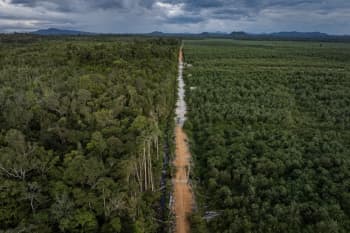
Clearing for Indonesia's Food and Energy Estates. Credit: Yusuf Wahil/Mighty Earth
Clearing for Indonesia's Food and Energy Estates. Credit: Yusuf Wahil/Mighty Earth


Mighty Earth CEO Glenn Hurowitz speaks at an official UN event at COP30
Mighty Earth CEO Glenn Hurowitz speaks at an official UN event at COP30

Mighty Earth protests to protect the Amazon Soy Moratorium at COP30
Mighty Earth protests to protect the Amazon Soy Moratorium at COP30
Protecting Indonesia's Forests
Stopping the World’s Largest Deforestation Project
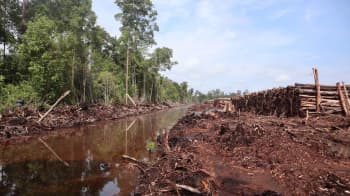
In 2025, we continued to build a global movement to persuade the Indonesian government to stop or redirect its 'Food and Energy Estates' project, which threatens 7 million acres of rare forest, savanna, and peatland habitat in South Papua.
While our advocacy and engagement with government officials continues to work towards alternative ways for Indonesia to meet its goals, our field investigations, webinars, and media work have brought global attention to what is likely the world’s largest deforestation project:
Excavators are used to clear forests in South Papua, Sunday, January 25, 2026. Mighty Earth/Yusuf Wahil
Excavators are used to clear forests in South Papua, Sunday, January 25, 2026. Mighty Earth/Yusuf Wahil
Media Clips: Food & Energy Estates
We believe there is an opportunity to stop the destruction while still achieving the growth Indonesia’s government seeks. The country’s palm oil, paper, and rubber companies have, for more than a decade, been successfully channeling their continued development onto the more than 20 million acres of previously deforested or degraded land instead of destroying pristine ecosystems. We think a similar solution exists now.
But instead, this Food and Energy Estates project threatens to undermine all that hard-won progress – as well as President Prabowo Subianto’s own climate pledges, including a net zero emissions target by 2060 – if the bulldozing continues at its current pace.
In the aftermath of devastating climate- and deforestation-exacerbated floods that claimed more than 1,000 lives in Sumatra in late 2025, President Prabowo threatened fines and suspensions for any companies that had been operating in breach of environmental permits and acknowledged the role climate change had played in the disaster (right).
In the weeks since, he has continued to acknowledge the risks of environmental destruction, telling the World Economic Forum in early 2026 that Indonesia wants “to be a good neighbor, a good responsible citizen of the world, protecting the environment, protecting nature. We must not destroy nature, we must live with nature.”
Mighty Earth will continue to work to convince President Prabowo to seize this moment, put the Food Estates project on pause, and help Indonesia fulfill its potential as a climate and nature superpower.
Green Century Director of Shareholder Advocacy (and Mighty Earth board member) Annie Sanders (fourth from right) was part of a delegation that included a former U.S. Ambassador to Indonesia and institutional investors from Australia, Britain, Canada, the Netherlands, Norway, Singapore and the U.S. In meetings with Indonesian officials, they discussed approaches the government could pursue to continue its crop production efforts while simultaneously protecting forests.
Green Century Director of Shareholder Advocacy (and Mighty Earth board member) Annie Sanders (fourth from right) was part of a delegation that included a former U.S. Ambassador to Indonesia and institutional investors from Australia, Britain, Canada, the Netherlands, Norway, Singapore and the U.S. In meetings with Indonesian officials, they discussed approaches the government could pursue to continue its crop production efforts while simultaneously protecting forests.
Participants discussion during the Merauke Solidarity Declaration at Petrus Vertenten Merauke, Thursday, March 13, 2025. Credit: Mighty Earth/Yusuf Wahil
Participants discussion during the Merauke Solidarity Declaration at Petrus Vertenten Merauke, Thursday, March 13, 2025. Credit: Mighty Earth/Yusuf Wahil
“Climate change, global warming and environmental damage. These are issues we must confront...We must truly prevent the cutting down of trees and the destruction of forests. We must also keep our rivers clean so they can carry sudden surges of water. Ladies and gentlemen, this will be our shared responsibility, with every household playing its part.”
Floods in Padangsidimpuan, North Sumatra, caused by Cyclone Senyar. Source: Indonesian National Board for Disaster Management
Floods in Padangsidimpuan, North Sumatra, caused by Cyclone Senyar. Source: Indonesian National Board for Disaster Management
Exposing the links between deforestation and American RVs
In 2025, Mighty Earth also helped expose recent cases of destruction in Borneo, Indonesia, where rogue deforester Mayawana Persada had cleared vast areas of carbon-rich peatland and orangutan habitat to make plywood.
The meranti trees found in the Mayawana Persada concession are favored by the American RV industry. According to industry insiders, the RV industry has been using meranti since the 1970s due its strength, flexibility and affordability. The plywood harvested from the Mayawana Persada concession was shipped abroad to the United States and likely made its way into RVs made by Winnebago, Thor, and Forest River.
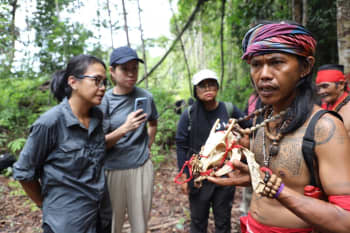
Mighty Earth traveled into the field alongside our allies – and a reporter from the New York Times – to uncover the links between ecological destruction and the U.S. RV industry.
Mighty Earth Forest Commodities Director Amanda Hurowitz with Satya Bumi, Link-AR Borneo, The NY Times team, and Indigenous Dayak men from Sabar Bubu.
Mighty Earth Forest Commodities Director Amanda Hurowitz with Satya Bumi, Link-AR Borneo, The NY Times team, and Indigenous Dayak men from Sabar Bubu.
We uncovered ecological destruction and rights violations of the local and Indigenous people, including destruction of sacred sites, equipment sabotage, destruction of food stores, and more. You can read our full investigation here.
Our findings also provided the basis for a front-page New York Times story:
Mighty Earth's Amanda Hurowitz, who traveled to Indonesia and helped conduct the investigation, with the front-page story about rainforest plywood.
Mighty Earth's Amanda Hurowitz, who traveled to Indonesia and helped conduct the investigation, with the front-page story about rainforest plywood.
In 2026, we will continue to leverage the findings of these investigations to exert public pressure on the American RV companies, encouraging them to update their sourcing standards and avoid purchasing wood products that kill orangutans and violate human rights.
Fighting for the Amazon Soy Moratorium
1. Direct Engagement with Companies & Sectoral Initiatives
Alongside public campaigning, Mighty Earth engaged directly with companies across the soy and meat supply chains through a series of bilateral meetings.
These discussions focused on urging companies to uphold sourcing criteria aligned with the Amazon Soy Moratorium (ASM), and to maintain or publicly reaffirm their commitments to deforestation-free supply chains, even in the absence of a collective mechanism.
In parallel, Mighty Earth worked to influence key sectoral initiatives and coalitions to explicitly integrate and defend equivalent criteria within their frameworks.
2. Expanding Protections to Other Ecosystems
Recognizing the growing risks beyond the Amazon biome, Mighty Earth also advocated for the expansion of existing safeguards to other critical ecosystems.
This includes promoting the integration of Other Wooded Lands (OWL) and strengthening commitments through the adoption of a 2020 cut-off date, in line with emerging international standards.
This approach aims to prevent leakage and ensure that progress in one biome is not offset by destruction in another.
3. Contribution to Public Debate and Market Pressure
These combined efforts contributed to maintaining high visibility of the ASM at a critical moment (COP30), reinforcing its importance as a cornerstone of deforestation-free supply chains, and increasing pressure on key market actors to clarify and strengthen their positions.
4. Link to Protein Transition
Protecting the ASM is also critical to the credibility of global protein transition strategies.
Soy used for animal feed remains a key driver of deforestation, and the integrity of supply chains supplying the meat and dairy sectors depends heavily on robust mechanisms such as the ASM.
5. Contribution to Public Debate and Market Pressure
In our corporate engagement, Mighty Earth has urged companies not only to support the Amazon Soy Moratorium (ASM), but also to implement its criteria independently, ensuring deforestation-free sourcing regardless of the agreement’s future.
Looking ahead, we will continue to push for stronger deforestation- and conversion-free (DCF) supply chains, building on ASM principles, expanding protection to other ecosystems, and improving traceability and enforcement across both company-level and sector-wide commitments.
“The suspension of the Amazon Soy Moratorium paves the way for further deforestation in one of the planet’s most vital ecosystems, pushing it ever closer to an irreversible tipping point…Without this safeguard, soy expansion could drive forest destruction not only in the Amazon, but also in the Cerrado and the Pantanal.”
Since 2006, major animal feed traders have agreed not to purchase soy grown on areas deforested after July 2008, even if the deforestation was legal. This agreement, the Amazon Soy Moratorium (ASM), has been a huge success. The policy saved 17,000 square kilometers of Amazon rainforest – an area twice the size of Wales – in its first decade, and has been the quintessential environment-economic win-win: the Brazilian soy industry has expanded by more than six million acres by focusing development on previously converted lands instead of destroying intact ecosystems, even as the rainforest has been able to recover.
But in 2025, more than 20 key companies – headlined by ADM, Bunge, and Cargill – pulled out of the ASM. The collapse of the ASM could expose 3 million acres of forest to deforestation for soy. Deforestation in the Amazon could increase by as much as 30% by 2045, accelerating the tipping point of no return for this essential biome.
Allowing this destruction is short-sighted. It will undermine Brazil’s climate targets. Even more absurd, many of the companies abandoning the Moratorium – and their customers – had pledged to eliminate all destruction of native ecosystems within their supply chains by the end of 2025.
So when it became clear that this key forest-protection mechanism was threatened, Mighty Earth leapt into action.
Just before the Climate Summit in Belém, Mighty Earth released a new report as part of our Rapid Response monitoring program in Latin America. Our analysis revealed the presence of soy logistics projects in the Amazon supported by the main traders, developed several years in advance, which are being used to justify actions against this protective mechanism. The report monitored the ongoing threats to the Amazon and the Cerrado from soy expansion, demonstrating the clear need for robust forest protections like the ASM right at this critical moment.
Mighty Earth then hosted a webinar, in Portuguese and English, featuring key experts from civil society, Brazilian government, and international industry – "Approaches to Support the Amazon Soy Moratorium in the Lead-Up to COP30" – to highlight the ASM's successes.
Capitalizing on this momentum, we launched a drive that invited companies, civil society organizations, and public institutions to pledge their support for the ASM in the lead-up to COP 30. And in our corporate engagement efforts with targets across our global protein transition campaign, we are still encouraging companies to speak out in support of the ASM - or to affirm that they will abide by its standards even if the formal mechanism is dismantled.
At the Climate Summit, Mighty Earth joined in the Unified Global March with a clear call to action: Save the Amazon Soy Moratorium!
In 2026, Mighty Earth will continue pressuring the companies that sell the meat raised on Latin America-grown animal feed to act. The ASM has underpinned their own forest saving commitments for decades; now they must act to protect it. To date, global retailers haven’t even suspended purchases from the worst deforestation culprits like Cargill or Bunge, who are responsible for the bulk of nature destruction in the animal feed industry.
If the ASM fails, the meat industry, responsible for more deforestation than the rest of agriculture combined and more climate pollution than all the cars in the world, will have lost its main example of corporate responsibility.
But Mighty Earth will continue campaigning to hold the entire supply chain – from the agribusiness feed producers to the giant meat companies to the global retailers – accountable for the environmental destruction it causes. And if these companies continue to sit idly by - or, worse, actively dismantle what progress has been made – they will find themselves once again explaining to an angry public why their products are being produced amidst the ashes of the Amazon.
World Firsts for the Meat Industry
The meat industry causes more climate pollution than all the cars, trucks, ships, and planes in the world combined. A major source of this pollution is methane – a short-lived but super-polluting greenhouse gas. Because methane is roughly 80 times more potent than carbon dioxide over a 20 year-period, implementing rapid cuts to methane emissions is one of the fastest levers to slow near-term warming. Mighty Earth and our allies have been advocating for retailers – and the meat and dairy companies that supply them – to take responsibility for accounting for methane, disclosing their emissions and enacting plans to reduce them.
In 2025, Mighty Earth’s corporate advocacy and engagement led directly to two world firsts on methane. Working alongside Changing Markets Foundation, we released research showing that none of the world’s 20 largest supermarket chains were disclosing their methane emissions. We then published an in-depth follow-up report focused on Ahold Delhaize, which, with more than 7,600 stores across 10 countries and 2024 revenue of nearly $100 billion, is one of the world’s largest supermarket companies.
Mighty Earth Netherlands Director Jurjen de Waal presented to Ahold Delhaize’s CEO at their 2025 shareholder meeting, and we worked with Dutch think tank QuestionMark on a “Green Superlist” that ranks retailers on environmental impact.
The pressure paid off. In July, Albert Heijn, the largest retailer in The Netherlands and the flagship Dutch brand of Ahold Delhaize, became the first major supermarket to publicly disclose its methane emissions, reporting that methane accounted for about 14% of its total climate pollution in 2024.
The second major breakthrough came at COP30 in Belém, Brazil. There, at a Mighty Earth event at the Super Pollutant Solutions Pavilion, Brazil’s Marfrig became the world’s first meat company to disclose its Scope 3 methane emissions and outline a methane reduction strategy, including a methane reduction target of 33% by 2035. This announcement built on the company’s previous commitment to eliminate all deforestation and ecosystem destruction throughout their supply chains.
While transparency is only the first step, it’s an important one. For years, companies have claimed that calculating their methane emissions was too complex. Transparency from retailers like Albert Heijn and meat companies like Marfrig will give Mighty Earth momentum to push for additional disclosures throughout the meat and retail industries in 2026.
Mighty Earth will continue to push these companies to go beyond disclosure and take concrete action to actually reduce their methane emissions, including boosting sales of plant-based alternatives and investing in alt proteins (in the case of retailers) and setting overall methane and climate targets.
Mighty Earth's report on Ahold Delhaize's methane emissions, April 2025
Mighty Earth's report on Ahold Delhaize's methane emissions, April 2025
Mighty Earth met with Marfrig’s Sustainability and Compliance team in their São Paulo headquarters in April 2025
Mighty Earth met with Marfrig’s Sustainability and Compliance team in their São Paulo headquarters in April 2025
“The idea is to show that it is possible to do this, and Marfrig is doing it. Now we must engage the whole sector and together we can really make a difference to the big, global challenge that we have.”
“This is just the beginning. There is a lot more work to be done to curb methane emissions, and we’re calling on the rest of the field to follow suit, particularly super polluters such as JBS.”
Bringing Catamounts Home
In 2025, Mighty Earth launched our first official rewilding campaign in the United States.
Mountain lions, also known as pumas or cougars, and best-known locally in Vermont as catamounts, are a keystone species whose return would offer tremendous benefits to the forest ecosystems of the northeast United States.
Mighty Earth hired our first Rewilding Director, Renee Seacor, and kicked off our “Bring Catamounts Home” effort in Vermont with the help of the stellar volunteers on our Rewilding Advisory Board.In 2025, we also launched a new online home for the campaign and have begun holding meetings with policymakers, senior political leaders, scientific experts, and state agency officials.
Renee has been hosting community events across the northeast U.S., including a talk from advisory board member Beth Pratt in Burlington, Vermont, and a series of “Catamount Conversations” in different communities to energize supporters, recruit volunteers, and answer common questions throughout the region.
Beth Pratt – cougar advocate, author of When Mountain Lions Are Neighbors, leader of the Save LA Cougars campaign, and Mighty Earth Rewilding Advisory Board member – joined Mighty Earth for an event in Burlington, Vermont. Credit: Mighty Earth
Beth Pratt – cougar advocate, author of When Mountain Lions Are Neighbors, leader of the Save LA Cougars campaign, and Mighty Earth Rewilding Advisory Board member – joined Mighty Earth for an event in Burlington, Vermont. Credit: Mighty Earth
Our communications team brought national attention to the campaign through major articles in The Guardian and The Washington Post.
In 2026, Mighty Earth will continue to build on this momentum across the northeast United States, paving the way for a catamount reintroduction guided by community input and the best available science.
Meet Our Rewilding Advisory Board:
Mark Burget serves as Vice President of Strategic Initiatives at Re:wild
Mark Burget serves as Vice President of Strategic Initiatives at Re:wild
Ben Goldsmith has been a pioneer in the field of sustainable investment and a longstanding advocate for nature restoration and rewilding.
Ben Goldsmith has been a pioneer in the field of sustainable investment and a longstanding advocate for nature restoration and rewilding.
Dr. Thomas S. Kaplan is a Franco-American entrepreneur, philanthropist, environmentalist, and art collector.
Dr. Thomas S. Kaplan is a Franco-American entrepreneur, philanthropist, environmentalist, and art collector.
Chris Klyza is the inaugural holder of the Robert ’35 and Helen ’38 Stafford Chair in Public Policy and Professor of Political Science and Environmental Studies at Middlebury College
Chris Klyza is the inaugural holder of the Robert ’35 and Helen ’38 Stafford Chair in Public Policy and Professor of Political Science and Environmental Studies at Middlebury College
A lifelong advocate for wildlife, Beth Pratt has worked in environmental leadership roles for over thirty years, and in two of the country’s largest national parks: Yosemite and Yellowstone.
A lifelong advocate for wildlife, Beth Pratt has worked in environmental leadership roles for over thirty years, and in two of the country’s largest national parks: Yosemite and Yellowstone.
Dick Raines recently retired from Carfax, where he was CEO for 30 years. He lives in rural Virginia and is active in environmental conservation organizations.
Dick Raines recently retired from Carfax, where he was CEO for 30 years. He lives in rural Virginia and is active in environmental conservation organizations.
Clay Rockefeller dedicates his volunteer efforts and philanthropy to fostering a more compassionate, just, creative, and healthy ecosystem for all.
Clay Rockefeller dedicates his volunteer efforts and philanthropy to fostering a more compassionate, just, creative, and healthy ecosystem for all.
Rick Ridder is President and Co-Founder of RBI Strategies and Research, as well as a former presidential campaign manager and a senior consultant for six other presidential campaigns.
Rick Ridder is President and Co-Founder of RBI Strategies and Research, as well as a former presidential campaign manager and a senior consultant for six other presidential campaigns.
Kristine Tompkins is the president and co-founder of Tompkins Conservation, an American conservationist, and former CEO of Patagonia, Inc.
Kristine Tompkins is the president and co-founder of Tompkins Conservation, an American conservationist, and former CEO of Patagonia, Inc.
2025 Victories in Brief
Forest Commodities
- Early in 2025, South Korea announced it would reduce biomass subsidies. Biomass – falsely labeled as a sustainable source of energy – drives forest destruction around the world so facilities can burn wood pellets for energy, emitting more carbon than coal. Mighty Earth’s work alongside Solutions for our Climate, our South Korean partner, included a report showing the impact of biomass in Indonesia and a Rapid Response case to increase visibility.
- Mighty Earth published our 50th Rapid Response palm oil report, marking eight years of successful monitoring that helped achieve a 90% decline in commodity deforestation in Southeast Asia, resulted in more than 60 palm oil suppliers adopting forest and human rights policies, and led to more than 275 bad actors being suspended.
- A new report by Mighty Earth, Cameroon on the Brink: Cocoa’s New Deforestation Frontier reveals that Cameroon is becoming the next major hotspot for cocoa-driven deforestation.
Protein Transition
- Our Rapid Response reports in Latin America drove companies to drop almost 1,000 non-compliant suppliers linked to deforestation in Brazil, sending a signal that destruction of nature leads to rapid loss of market access
- In addition to driving the world-first actions by Marfrig (the world’s second-largest beef company) and Ahold Delhaize subsidiary Albert Heijn on methane described above, we also engaged 10 of the world’s largest meat companies and 28 of the leading food retailers across Europe, the US and Asia on ways to reduce their methane emissions.
- Mighty Earth worked with retailers to increase their sales and marketing of plant-based proteins, with many showing robust sales. Carrefour has even met, exceeded, and increased their goal on plant-based sales.
Industrial Decarbonization
We continued to pressure Hyundai and other auto companies to clean up their supply chains in the race to create a truly sustainable electric vehicle.
- We published a report detailing the devastating impacts of Hyundai’s steel supply chain on people and planet, ranging from greenhouse gas emissions and life-threatening pollution to exploitative labor practices and ties to dirty Russian coal.
- Hyundai announced its new Louisiana facility would use green hydrogen to make steel, with plans to become a catalyst for the hydrogen ecosystem in the state
Legal Filings & Corporate Accountability
- Mighty Earth filed a lawsuit in Washington, D.C., against JBS USA for alleged false statements about achieving net zero by 2040.
- We also filed a complaint with the UK Financial Conduct Authority calling for an investigation into potential fraud and greenwashing by Barclays for underwriting $3 billion in Sustainability-Linked Bonds issued by JBS.
- Mighty Earth joined the Transnational Legal Coalition to work with other organizations on further legal opportunities to drive impact.
- We also continued to work with Indigenous allies from South America on our groundbreaking lawsuit in France against supermarket chain Casino, the first legal action to hold a supermarket accountable for both deforestation and Indigenous land grabbing. The trial has been set for mid-2026.
Our Team
Staff
Glenn Hurowitz
CEO and Founder
Phil Aikman
Senior Advisor, Forests
Alex Armstrong
Vice President, External Affairs
Carlos Bravo Villa
Senior Advisor, Spain
Jonathan Byers
Geospatial Analyst
Munya Chitambo
Staff Accountant
Jurjen de Waal
Senior Director, Netherlands
Brenda Diniz
Campaigner & Social Mobilizer
Molly Dorozenski
Vice President, Campaigns and Investigations
Isabel Fernández Cruz
Senior Advisor, Spain
Mariana B. Perozzi Gameiro
Senior Advisor, Brazil
João Gonçalves
Global Director, Protein Transition Campaign
Matthew Groch
Senior Director, Heavy Industry
Jon Haddad
Senior Associate, Heavy Industry
Sammy Herdman
Senior Campaigner for Climate, Food, and Agriculture
Anna Hong
Managing Director of Finance and Operations
Gemma Hoskins
Global Climate Director
Tim Hudspeth
Senior Associate, Finance and Grants
Amanda Hurowitz
Senior Director, Forest Commodities
Sydney Jones
Press Secretary
Deborah Lapidus
Senior Advisor
Samuel Mawutor
Senior Advisor
Jordan McDonald
Manager, Protein Transition Campaign
Carole Mitchell
Global Communications Director
Casey Nitsch
Senior Development Director
Thea Parson
Manager, Forests & Climate
Boris Patentreger
Senior Director, France; Lead, Protein Deforestation Program
Meihua Piao
East Asia Manager
Renee Seacor
Rewilding Director
Roger Smith
Japan Director
Amourlaye Touré
West Africa Representative
Kristin Urquiza
Senior Advisor, Restoration and Rewilding
Alex Wijeratna
Senior Director, Legal and Investigations
Katie Yared
Senior Associate, Forests and Climate
Board of Directors
Glenn Hurowitz
CEO and Founder
Tom Kuo
Board Chair
Anand Gopal
Board Member
Ari Nessel
Board Member
Heidi Overbeck
Board Member
Ken Pucker
Treasurer
Annie Sanders
Board Member
Abdul Tejan-Cole
Board Member
2025 Financial Statement
Total expenses for the fiscal year 2025 were $6,122,842, supporting our programs and mission-driven activities throughout the year. We aspire to be the most effective environmental advocacy organization in the world, and are already among the most efficient: only 6% of our spending went to fundraising activities, with 94% of our budget dedicated to program activities and operations.
Numbers are from unaudited 2025 financials.
Ways to Give
There are many ways to support Mighty Earth and defend a living planet. To learn more or make a donation, please contact casey@mightyearth.org.
Make A One-Time Donation
Become a Mighty Earthling and support our efforts with a onetime donation.
Give A Monthly Donation
Recurring monthly donations help us be nimble and flexible.
Give Through Your Donor Advised Fund
You can make a powerful impact on Nature and Climate by giving through your donor advised fund.
Donate By Mail
You can mail your check or money order to:
1701 Rhode Island Ave. NW
Suite 3-123
Washington DC 20036
Wire Your Donation
Email casey@mightyearth.org to obtain the wire transfer information needed by your bank.
Make A Qualified Charitable Distribution From Your IRA
Make a powerful impact and potentially save on your taxes by making a qualified charitable distribution.
Donate Online
Visit www.mightyearth.org/donate to give quickly and easily through our website.
Mighty Earth 2025 Annual Report
By Alex Armstrong
© 2026
www.mightyearth.org
 Built with Shorthand